

Clinical Data for KEYTRUDA® (pembrolizumab) + WELIREG® (belzutifan) in Certain Adults With Clear Cell RCC at Increased Risk of Recurrence in the Adjuvant Setting
WELIREG, in combination with KEYTRUDA or KEYTRUDA QLEX, is indicated for the adjuvant treatment of adult patients with renal cell carcinoma with a clear cell component (ccRCC) at intermediate-high or high risk of recurrence following nephrectomy, or following nephrectomy and resection of metastatic lesions.
The effectiveness of KEYTRUDA QLEX for its approved indications has been established based upon evidence from the adequate and well-controlled studies conducted with KEYTRUDA and additional data comparing the pharmacokinetic, efficacy, and safety profiles of KEYTRUDA QLEX and KEYTRUDA.

EFFICACY
In adult patients with ccRCC at intermediate-high or high risk of recurrence following nephrectomy, or following nephrectomy and resection of metastatic lesions
LITESPARK-022: Superior DFS with KEYTRUDA + WELIREG vs KEYTRUDA + placebo
Kaplan-Meier Estimates of DFS in LITESPARK-022
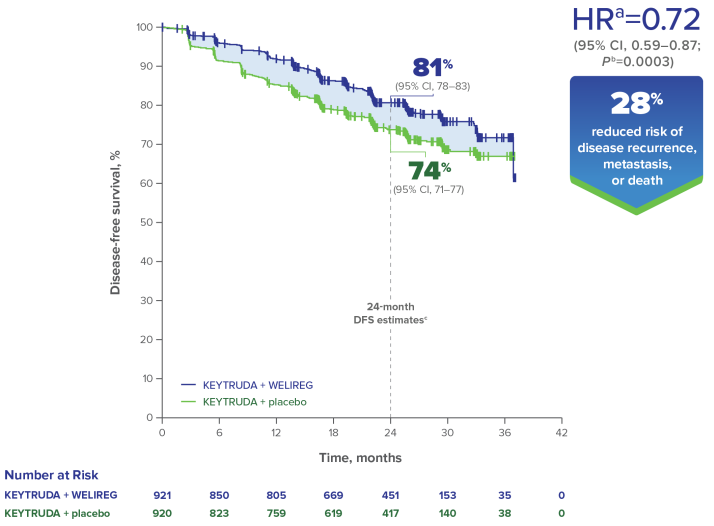
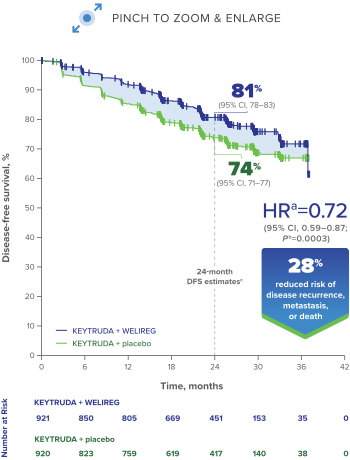
- DFS events occurred at a higher percentage with KEYTRUDA + placebo (27%; 246/920) than with KEYTRUDA + WELIREG (20%; 186/921). DFS was defined as time to recurrence, metastasis, or death
- Median DFSc: Not reached for KEYTRUDA + WELIREG (95% CI, 36.9–NR) or KEYTRUDA + placebo (95% CI, NR–NR)
- At the time of this prespecified interim analysis, OS results were not mature
HR based on the stratified Cox proportional hazard model.
P-value based on stratified log-rank test.
Based on Kaplan-Meier estimates.
CI = confidence interval; DFS = disease-free survival; HR = hazard ratio; NR = not reached; OS = overall survival.
STUDY DESIGN
LITESPARK-022: Head-to-head phase 3 study of KEYTRUDA + WELIREG vs KEYTRUDA + placebo in 1,841 patients with ccRCC at increased risk of recurrence following surgery
LITESPARK-022 was a large, multicenter, double-blind, randomized, phase 3 clinical study that evaluated KEYTRUDA + WELIREG as adjuvant treatment of ccRCC

Randomization was stratified by risk of recurrence (intermediate-high vs high risk vs M1 NED) and tumor grade (1 or 2 vs 3 or 4).
- DFS, defined as time to recurrence, metastasis, or death, as assessed by the investigator
- Overall survival (OS)
Key eligibility criteria
- ccRCC following nephrectomy
- Intermediate-high or high risk of recurrence of RCC or M1 NED
- The intermediate-high–risk category included grade 4 pT2N0M0 or any grade pT3N0M0.
- The high-risk category included any grade pT4N0M0 or any grade pT1–4N1M0.
- The M1 NED category included patients with metastatic disease who had undergone complete resection of primary and metastatic lesions.
- Patients were required to have undergone a partial or radical nephrectomy, and if indicated, metastasectomy within 2 years of nephrectomy, within ≥4 weeks prior to the time of screening
- Prior systemic therapy for advanced RCC
IV = intravenous; M0 = no distant metastasis; M1 = distant metastasis; N0 = no regional lymph node metastasis; N1 = metastasis in regional lymph node(s); NED = no evidence of disease; pT1 = tumor ≤7 cm in greatest dimension, limited to the kidney; pT2 = tumor >7 cm in greatest dimension, limited to the kidney; pT3 = tumor extends into major veins or perinephric tissues but not into the ipsilateral adrenal gland and not beyond Gerota's fascia; pT4 = tumor invades beyond Gerota's fascia (including contiguous extension into the ipsilateral adrenal gland; Q6W = every 6 weeks; RCC = renal cell carcinoma.
PATIENT POPULATION
LITESPARK-022 study population characteristics
LITESPARK-022 study population characteristics

- Median age: 60 years (range: 20 to 91 years); 32% aged ≥65 years
- Male: 71%
- Race: White, 63%; Asian, 29%; Unknown, 3.6%; Black or African American, 0.7%; American Indian or Alaska Native, 1.7%; Multiracial, 1.8%
- Ethnicity: Not Hispanic or Latino, 78%; Hispanic or Latino, 15%; Unknown, 7%
- ECOG PS 0: 85%; ECOG PS 1: 15%
- N0 or unknown nodal status: 96%
- Sarcomatoid features: 10%
- Radical nephrectomy: 90%; Partial nephrectomy: 10%
85% of patients in LITESPARK-022 were at intermediate-high risk of recurrence following nephrectomy

In LITESPARK-022, patients were classified according to pathological tumor staging.
AJCC = American Joint Committee on Cancer; ECOG PS = Eastern Cooperative Oncology Group performance status; M = metastasis; N = lymph node involvement; T = primary tumor.
SAFETY
Adverse reaction profile for LITESPARK-022
The safety of KEYTRUDA + WELIREG was evaluated in LITESPARK-022. A total of 915 patients received KEYTRUDA + WELIREG and a total of 913 patients received KEYTRUDA + placebo
- KEYTRUDA: 11.1 months (range: 1 day–16.1 months)
- WELIREG: 12.4 months (range: 1 day–20.1 months)
Serious adverse reactions in ≥1% of patients included pneumonia (2%), hypoxia (1.9%), pneumonitis (1.6%), arrhythmia (1.5%), diarrhea (1.1%), and acute kidney injury (1.1%)
Fatal adverse reactions occurred in 1.1% of patients who received KEYTRUDA + WELIREG, including sepsis (0.1%).
- KEYTRUDA: 23%
- WELIREG: 27%
Adverse reactions that resulted in permanent discontinuation of KEYTRUDA in ≥1% of patients included increased ALT (4.5%), increased AST (3%), pneumonitis (2.4%), diarrhea (2.4%), and rash (1.5%).
Adverse reactions that resulted in permanent discontinuation of WELIREG in ≥1% of patients included anemia (4%), fatigue (2.2%), rash (2%), increased ALT (1.7%), hypoxia (1.6%), diarrhea (1.4%), pneumonitis (1.3%), increased AST (1.1%), and hepatic function abnormal (1%).
- KEYTRUDA: 29%
- WELIREG: 52%
Adverse reactions that required dosage interruption of KEYTRUDA in ≥2% of patients included anemia (3.2%), diarrhea (3%), increased ALT (3%), and increased AST (2.5%).
Adverse reactions that required dosage interruption of WELIREG in ≥2% of patients included anemia (25%), fatigue (3.7%), increased ALT (3.5%), diarrhea (3.4%), increased AST (3.4%), COVID-19 (2.6%), hypoxia (2.5%), pyrexia (2.5%), musculoskeletal pain (2.1%), and rash (2.1%).
Adverse reactions that required dose reduction in ≥3% of patients included anemia (17%), hypoxia (3.5%), increased ALT (3.2%), and fatigue (3.1%)
The most common (≥25%) adverse reactions, including laboratory abnormalities, in patients who received KEYTRUDA + WELIREG were decreased hemoglobin (95%), increased ALT (57%), fatigue (49%), increased AST (46%), decreased lymphocytes (38%), and increased alkaline phosphatase (29%).
Clinically relevant adverse reactions in <10% of patients who received KEYTRUDA + WELIREG included hypertension (7%), hypoxia (7%), visual impairment (6.1%), arrhythmia (5%), hemorrhage (4.6%), chest discomfort (2.6%), and palpitations (1.9%).
Anemia and hypoxia in LITESPARK-022
Monitor for anemia and oxygen saturation before initiation of, and periodically throughout, treatment
- 95% experienced decreased hemoglobin
- 11% experienced grade 3 or higher events
- Median time to onset of anemia was 42 days (range: 1 day to 11.1 months)
- 5% received transfusions only
- 8% received ESAs only
- 1.3% received both transfusion and ESAs
- 7% experienced hypoxia
- 5% experienced grade 3 or higher events
- 47% were treated with oxygen therapy
- Median time to onset of hypoxia was 93 days (range: 9 days to 11.7 months)
ESA = erythropoiesis-stimulating agent.
Select adverse reactions (≥10%) in patients with ccRCC who received KEYTRUDA + WELIREG (at a higher incidence [between-arm difference of ≥4%] compared to control) in LITESPARK-022
![Select Adverse Reactions (≥10%) in Patients With ccRCC Who Received KEYTRUDA® (pembrolizumab) + WELIREG® (belzutifan) (at a Higher Incidence [Between-Arm Difference of ≥4%] Compared To Control) in LITESPARK-022](/static/adverseTable-mob-86038d07aa41d88e781393524f356a51.svg)
Graded per NCI CTCAE v5.0.
Includes other related terms.
NCI CTCAE = National Cancer Institute Common Terminology Criteria for Adverse Events.
Select laboratory abnormalities (≥20%) that worsened from baseline in patients with ccRCC who received KEYTRUDA + WELIREG (at a higher incidence [between-arm difference of ≥10%] compared to control) in LITESPARK-022
![Select Laboratory Abnormalities (≥20%) That Worsened From Baseline in Patients With ccRCC Who Received KEYTRUDA® (pembrolizumab) + WELIREG® (belzutifan) (at a Higher Incidence [Between-Arm Difference of ≥10%] Compared To Control) in LITESPARK-022](/static/labtestTable-mob-03a15dbe91205d820194b258bd934847.svg)
Each test incidence is based on the number of patients who had both baseline and at least one on-study laboratory measurement available: KEYTRUDA + WELIREG, range: 907 to 911 patients; KEYTRUDA + placebo, range: 905 to 912 patients.
Graded per NCI CTCAE v5.0.
ALT = alanine aminotransferase; AST = aspartate aminotransferase.
Reference: 1. Rini BI, McKiernan JM, Chang SS, et al. Kidney. In: Edge SB, Greene FL, Byrd DR, et al, eds. AJCC Cancer Staging Manual. 8th ed. Springer International Publishing; 2017:739–748.
Explore information about dosing and administration, including dose modifications, for WELIREG, KEYTRUDA, and KEYTRUDA QLEX